


Sales
The Sales function fuels business success by identifying opportunities, developing proposals, closing deals, and aligning with strategy to drive revenue, expand markets, and build relationships.

Sales Functional Overview
he Sales function contributes to a firm’s overall strategic goals and objectives in several key ways:
- Revenue Growth: Sales drives revenue by acquiring new clients and expanding accounts, supporting financial objectives through consistent achievement of sales targets and sustained business generation.
- Market Expansion: Sales identifies new opportunities to reach broader markets, helping the firm grow geographically, diversify its client base, and maintain a competitive industry edge.
- Customer Relationships: Sales builds trusted relationships with clients, fostering repeat business, referrals, and long-term partnerships essential for stable, sustained growth and customer satisfaction.
- Strategic Alignment: Sales collaborates with internal teams to align offerings with market needs, ensuring strategy is informed by customer insight and supports firm-wide business objectives.
- Brand Positioning: Sales promotes the company’s value proposition to strengthen brand credibility, increase trust, and support long-term differentiation and competitiveness in the marketplace.
- Feedback Loop: Sales gathers field insights—client input, trends, and intelligence—to refine strategy, guide innovation, and help the company stay responsive to changing market conditions.
Sales Objectives
The sales function has the following objectives:
- Opportunity Identification: Discover and pursue new customer growth opportunities.
- Proposal Management: Develop and price compelling service proposals strategically.
- Deal Closure: Negotiate terms and finalize client agreements.
- Demand Forecasting: Estimate delivery resource needs based on pipeline.
Sales Critical Success Factors
Sales Critical Success Factors focus on optimizing pipeline management, partner collaboration, staffing excellence, and opportunity qualification—all essential for delivering sustainable business growth.
| CSF | DESCRIPTION |
|
Pipeline Velocity |
The Sales function must manage multiple sales cycles of variable length and complexity. By nature this can take a long amount of time to help the customer define their requirements in a way that positions Offerings optimally. |
| Channel Integration | The Sales function must integrate tightly with partner channel programs (marketing and sales) and leverage available resources. This includes representing a broad portfolio of manufacturer solutions. |
| Hire Qualified Staff | The Sales function must be populated with managers and staff who are experts at positioning service offerings, supported by a disciplined process for qualifying and hiring capable professionals. |
| Identify and Qualify Opportunities | The Sales function must implement methods and practices that align each sales pursuit with the right customer and offering, ensuring the best fit and highest chance of success. |
| Demand Forecasting Accuracy | The Sales function must accurately forecast demand for services by maintaining disciplined pipeline management, aligning opportunities to delivery capacity, and continuously refining projections based on deal progression. |
Sales Major Activities
The sales function is responsible for these major activities:
- Identify: Find and qualify prospects that match our ideal client profile.
- Develop: Engage prospects to understand needs and build relationships.
- Orchestrate: Coordinate stakeholders and resources to advance sales opportunities.
Sales Process
The sales process is a structured, end-to-end model to uncover opportunities, craft solutions, and coordinate execution for scalable growth and client success.
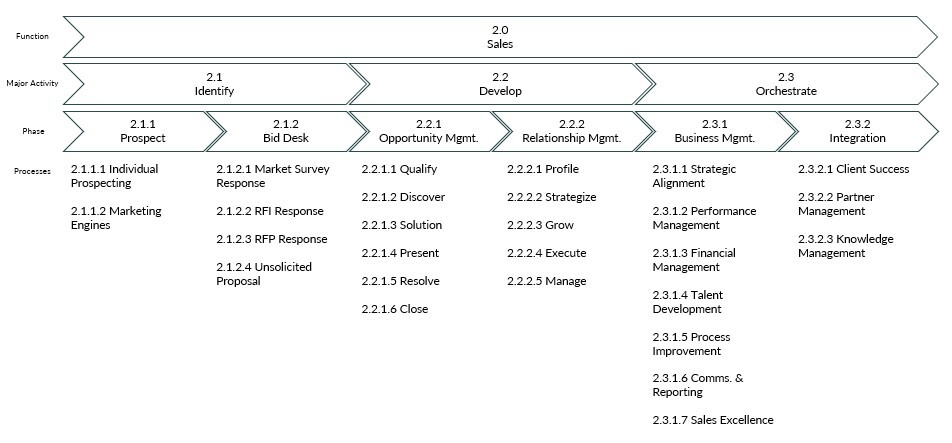
2.1.1 Prospect: Identify and engage potential clients through targeted outreach
2.1.2 Bid Desk: Respond to formal requests and develop structured proposal submissions
2.2.1 Opportunity Management: Qualify, develop, and advance opportunities through the sales lifecycle
2.2.2 Relationship Management: Build, grow, and manage long-term client relationships and accounts
2.3.1 Business Management: Align strategy, performance, and resources to support sales execution
2.3.2 Integration: Coordinate cross-functional teams to ensure successful deal delivery
Sales People
Sales professionals align solutions with customer needs to generate revenue, strengthen relationships, forecast demand, and ensure impactful, scalable client engagements across specialized sales functions.
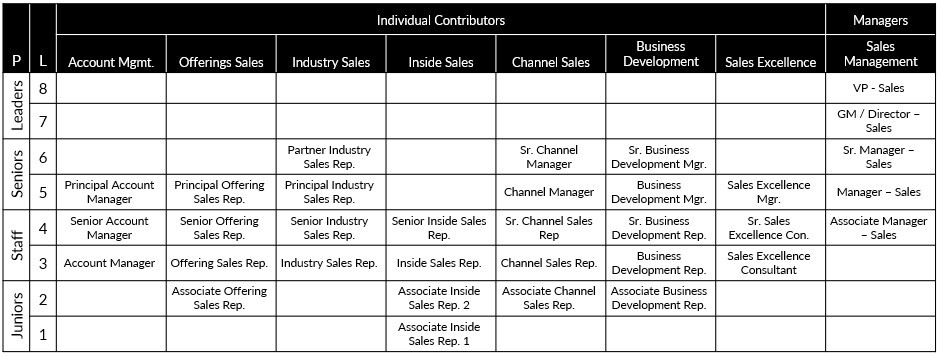
Account Management: Builds client relationships to drive renewals, expansion, and forecasting
Offering Sales: Positions offerings to align capabilities, accelerate deals, ensure fit
Industry Sales: Applies industry insight to qualify opportunities and tailor solutions
Inside Sales: Generates and qualifies leads, supports pipeline and handoffs
Channel Sales: Leverages partners to expand reach and close joint deals
Business Development & Strategy: Identifies growth opportunities, shapes strategy, supports strategic deal closure
Sales Excellence: Enhances productivity through tools, processes, training, and consistency
Sales Management: Leads teams, manages pipeline, ensures execution and accurate forecasting
Sales Technology
Sales Technology integrates platforms, data, and workflows to enable prospecting, deal execution, forecasting, and collaboration, improving pipeline quality, win rates, and scalable growth outcomes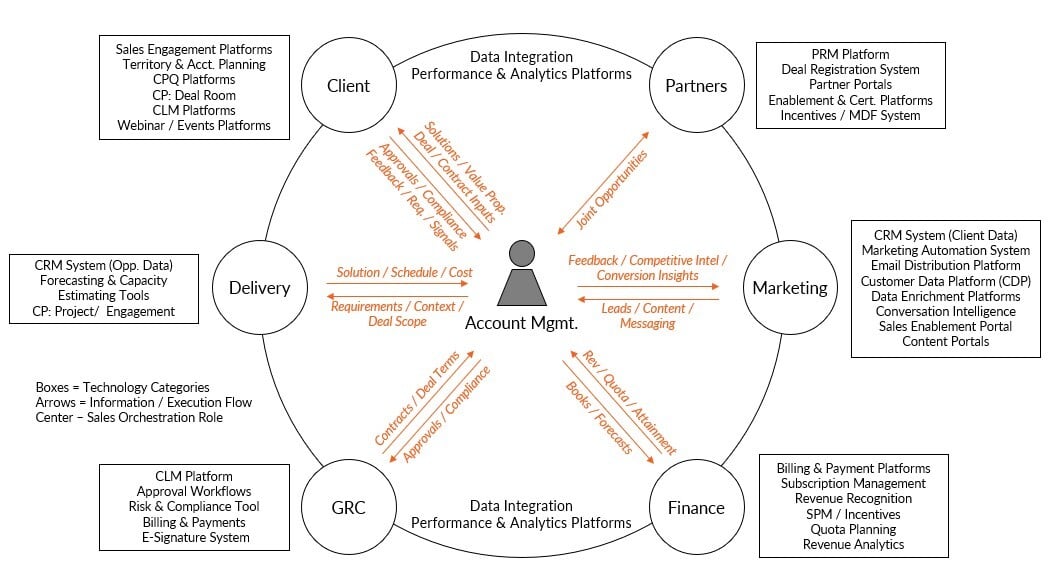
Owned Digital Experience Platform: Firm-controlled digital properties delivering branded online experiences. Platform types include Customer Portal - Deal Rooms, and Customer Portal - Project Portal.
Content Management Platform: Central platform enabling structured creation, management, and publishing of marketing content. Platform types include Sales & Marketing Portals.
Media & Distribution Platform: Third-party platforms used for distributing content expanding reach and engagement. Platform types include Email Distribution Platforms for sales-based campaigns and Account Based Marketing (ABM).
Marketing Execution Platform: Used to execute campaigns and drive engagement across marketing channels. Platform types include Marketing Automation Systems and Webinar & Events Platforms.
Customer Data & Identity Platform: Unify customer data to enable targeting and personalization. Platform types include Customer Data Platform (CDP) and Identity Resolution / Data Enrichment Platforms.
Relationship & Revenue Platform: Manage relationships and drive revenue through pipeline visibility. Platform types include customer relationship management (CRM) system, Sales Engagement Platforms , Configure, Price, Quote Platforms, Territory & Account Planning, Billing & Payments, Subscription Management (product-based firms), and Revenue Recognition Platforms.
Partner Platforms: Vendor-led platforms enable partner onboarding, collaboration, deal protection, training, and incentives. Platform types include Partner Relationship Management (PRM) Platforms, Deal Registration Systems, Partner Portals, Enablement & Training Platforms, and Incentive & MDF Systems.
Performance & Analytics Platform: Measure performance and optimize sales through data-driven insights. Platform types include Revenue Analytics, Sales Pipeline Analytics, Sales Performance Management (SPM), Quota Planning, and Forecasting Platforms.
Governance, Risk, and Compliance (GRC) Platform: Manage contracts approvals compliance risks and secure agreements. Platform Types include Contract Lifecycle Management (CLM) Platforms, Approval Workflows, Risk & Compliance Tools, and E-Signature Systems.
Delivery Planning & Execution Platform: Enable estimating capacity planning and project collaboration. Platform types include Estimating Tools, Capacity Planning & Resource Management Platforms, and Project / Engagement Portals (internal-only).
Enablement & Training Platforms: Deliver training coaching certifications and knowledge. Platform types include Sales Coaching / AI Assistants, Sales Enablement Portal, Partner Enablement Portal (firm-owned), Learning Management System (LMS) and Certification Tracking System.
Sales Interfaces
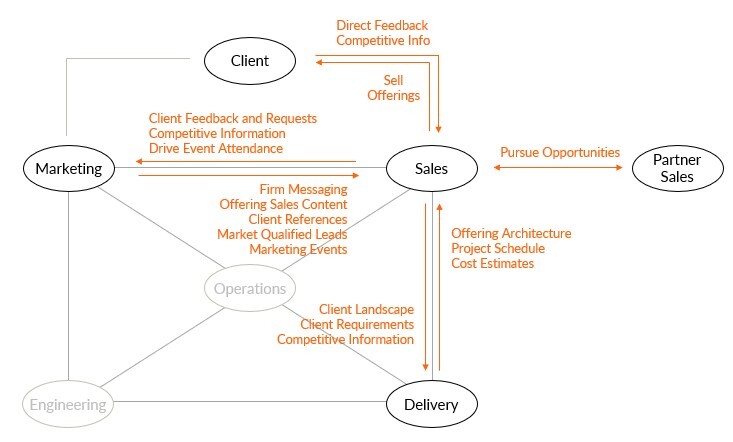
Sales interfaces connect with Marketing, Delivery, Clients, and Partners through structured exchanges of insights, messaging, and execution to align solutions with client needs and drive growth.
Sales Metrics
Sales Metrics measure pipeline, performance, conversion, forecasting, and revenue outcomes, providing data-driven insights to evaluate effectiveness, guide decisions, optimize execution, and drive continuous sales improvement